
Why Most Americans Are Underinsured — And Don’t Even Know It
There is a quiet financial crisis unfolding in households across America. It does not make headlines. It does not trigger emergency alerts. But according to industry data, more than half of American adults who carry life insurance are living with a dangerous illusion of security — believing they are protected when, in reality, their coverage falls critically short of what their family would actually need.
This is the underinsurance epidemic. And in 2026, it is accelerating.

The Numbers Don’t Lie
LIMRA’s most recent industry survey found that while 52% of Americans have some form of life insurance, the median coverage amount has not kept pace with the realities of modern household expenses. The average American family carries roughly $180,000 in life insurance coverage. Yet financial planners consistently recommend a minimum of 10 times annual income — meaning a household earning $70,000 per year should carry at least $700,000 in coverage.
The gap between what families have and what they actually need now averages $320,000 per household.
“We see this constantly,” says one senior financial planner with over two decades of experience. “A family thinks they are covered because they have a policy. But when we actually run the numbers — mortgage, childcare, education, daily living costs — the shortfall is staggering.”
Why This Happens
The underinsurance crisis is not the result of negligence. It is the predictable outcome of a system that was never designed to keep up with your life.
Most Americans purchase life insurance once — at a specific moment in time — and never revisit it. A 28-year-old who bought a $200,000 policy before getting married, buying a home, and having two children is now dramatically underprotected. The policy didn’t change. Life did.
At the same time, inflation has quietly eroded the real-world value of existing coverage. A $300,000 payout that felt substantial in 2018 has significantly less purchasing power in 2026. It would not cover the same mortgage balance, the same cost of living, or the same education expenses that existed when the policy was first written.
There is also the false comfort of employer-provided coverage. Millions of Americans rely on group life insurance through their workplace — typically one to two times their annual salary — without realizing that this coverage disappears the moment they change jobs, face a layoff, or retire.“A supplemental policy can fill that gap instantly — and getting a free quote takes less than five minutes.”

The Hidden Cost of Doing Nothing
The most dangerous aspect of underinsurance is that the consequences are entirely invisible — until they are not.
When a primary income earner passes away without adequate coverage, the financial fallout is immediate and compounding. Within the first 90 days, families face funeral costs averaging $12,000 to $15,000 out of pocket. Within six months, mortgage payments become unsustainable. Within a year, education plans are deferred, retirement savings are liquidated, and the surviving family members are forced to make life-altering financial decisions during the worst period of their lives.
No amount of savings reliably bridges that gap. A life insurance payout is the only financial instrument that delivers immediate, tax-free liquidity at exactly the moment a family needs it most — bypassing probate, market volatility, and bureaucratic delays entirely.
The question is not whether you have life insurance. The question is whether what you have is actually enough.
The 2026 Coverage Check: A Simple Formula
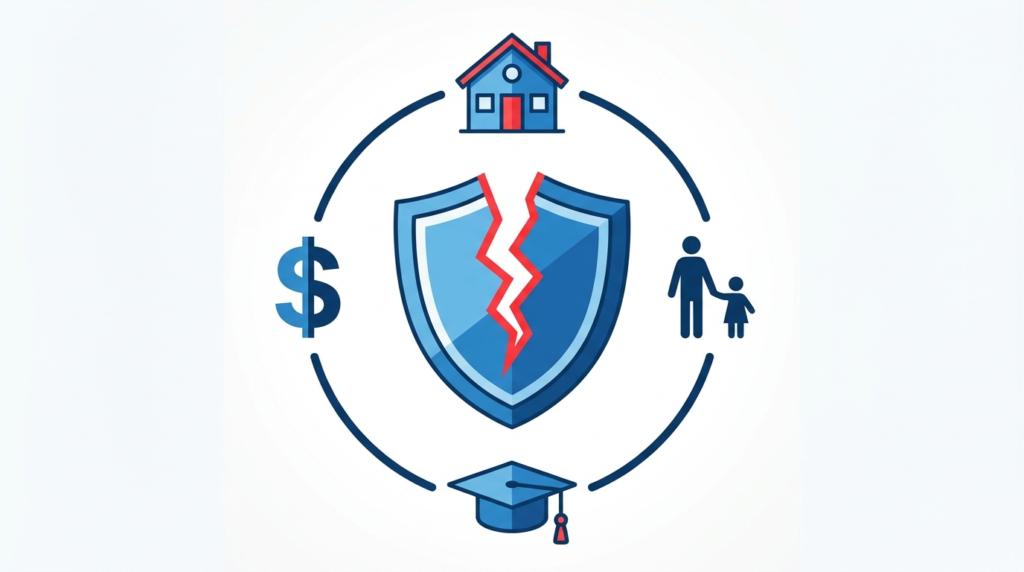
Determining whether you are underinsured does not require a financial advisor. A straightforward calculation tells you where you stand:Coverage Needed=(Annual Income×10)+Mortgage Balance+Education Costs−Existing Savings
If your current policy falls short of that number, you are underinsured. And you are far from alone.
The good news is that closing a coverage gap in 2026 is faster, easier, and more affordable than most people expect. Next-generation comparison platforms now allow qualified applicants to “review multiple top-rated carriers side by side and find the coverage that fits their exact situation — often in under ten minutes.”

What the Market Looks Like Right Now
For consumers who have not reviewed their coverage recently, the 2026 market offers a significant opportunity. Increased competition among carriers, combined with algorithmic underwriting that eliminates the need for medical exams, has driven premiums to historically competitive levels.
A healthy 35-year-old non-smoker can now access $500,000 in term life coverage for less than the cost of a monthly streaming subscription. A 45-year-old looking to close a coverage gap may find that the additional protection costs far less than anticipated — particularly when using a platform that shops multiple carriers simultaneously rather than locking into a single provider’s rates.
“The consumers who are winning in 2026 are the ones who treat life insurance as a living document,” notes one actuary at a leading risk analysis firm. “They review it when their income changes. When they buy a home. When they have a child. Because the policy that protected you five years ago may not be the policy that protects your family today.”
The Bottom Line
Having life insurance is not the same as having enough life insurance. For millions of American families, the policy sitting in a filing cabinet represents a fraction of the protection their household actually requires — and the gap is growing every year.
The 2026 market has removed every barrier that once made closing that gap difficult. No medical exams. No lengthy waiting periods. No confusing paperwork. Just a straightforward process that takes minutes and delivers the clarity your family deserves.
The only question left is whether you know where you actually stand.